
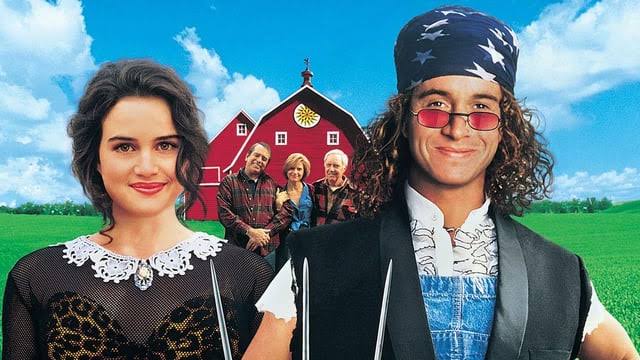


Pauly Shore was the ’90s. In every way, shape, or form, if that decade could walk and talk, it would manifest as Pauly Shore.
For several years, he went from MTV’s most chillin’ VJ to Hollywood’s own prophet of slack. If you needed someone to embody post-’80s aimlessness dressed as radical self-expression, The Weasel was your guy. With Son in Law (1993), Disney was again trying to bottle whatever Shore had and sell it to middle America. In fact, the movie plays out like the ’90s invading a part of the world that stopped marking the passage of time about a decade earlier.
Why This Fish-Out-of-Water Comedy Still Shines:
- The Weasel at His Peak: Dialed into Shore’s singular wavelength—that minute frequency where Valley speak meets rock-and-roll stoner philosophy meets genuine sweetness and vulnerability.
- Charming Counterculture Assimilation: Instead of changing the traditional farm family, Crawl (essentially Encino Man‘s Stoney with a college RA certificate) just wants to be himself and win them over with his groove.
- A Stacked ’90s Ensemble: Features a star-making turn by Carla Gugino as Rebecca, alongside great supporting roles from Lane Smith, Tiffani-Amber Thiessen, and an uncredited cameo by Flea.
In ’93, Shore was still riding high. Hollywood was betting on slacker comedies, MTV still dominated youth culture, and The Weasel had more movies in the pipeline. Nobody knew Bio-Dome would crater so hard it would take this whole persona with it—or that by ’97, the mainstream would repackage Gen X counterculture into something less Butthole Surfers and more… Goo Goo Dolls.
The Weasel would keep on weaselin’ for a few more years, but Son in Law caught him at his sweet spot, when his frequency and ’90s pop culture were perfectly aligned.
It was electric.

Leave a Reply