
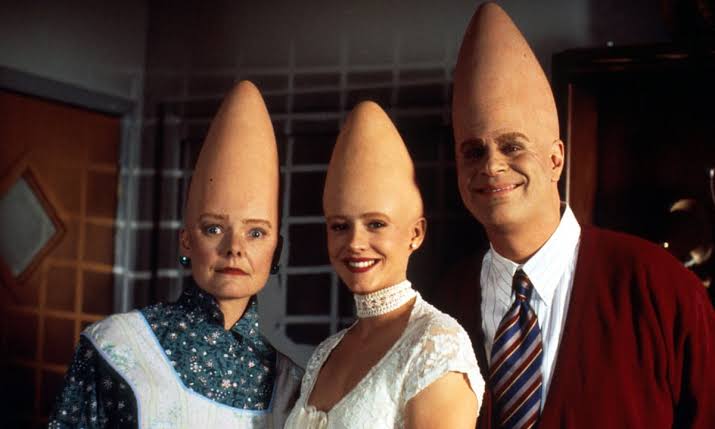


A year into the Wayne’s World phenomenon, Paramount was deep into its Saturday Night Live IP strip-mining operation looking for anything with built-in sketch appeal.
They seemed convinced they could replicate that success, but the trouble was, they didn’t quite understand why it worked. It went way beyond the catchphrase water-cooler zeitgeist that pre-sold the film—Wayne’s World managed to tap into its own irony, not to mention the no-sell-outs slacker sincerity of Gen X. Coneheads (1993) had none of that.
What it had instead was Dan Aykroyd in full-tilt post-Valkenvania weird mode, playing everything with a straight face and going all-in with its high-concept conceit.
Why This Late-’70s Sketch Revival Actually Works:
- Immigrant Subtext: Set in a typical ’90s suburban grid that was already teetering on the surreal (think Edward Scissorhands or Meet the Applegates), Beldar and Prymatt weren’t your typical space-invading extra-terrestrials—they were coded immigrants. They worked twice as hard, pushed their child to succeed, and assimilated so aggressively they started to out-American the Americans.
- Aykroyd’s Passion Project: Unlike most of the SNL movies that followed (Stuart Saves His Family, It’s Pat, Superstar, A Night at the Roxbury) which lived and died on weekly repetition, the Coneheads were a 1970s relic. Dan Aykroyd wasn’t just chasing a trend—he had a genuine story to tell about feeling like an outsider, stretching a five-minute gag into ninety minutes of soccer mom satire.
- Surprising Relatability: The real humor comes from how hard these characters try. Beneath the absurd alien jargon, they’re just a family navigating bureaucracy, parenting, and social faux pas while trying to build a life.
Of course, audiences didn’t have time for any of it. Coneheads crashed and burned at the box office, and no one walked away quoting “Maintain low tones” in the schoolyard. The feds chasing them was played as a joke back then, but the undercurrent of fear and the idea of an outsider having to constantly prove their worth to a system that will never fully accept them—well, that bell rings a bit louder now.
Under all its pointy latex and deadpan delivery, it was just a little sci-fi satire about a strange family who wanted to belong. And doggone it, I liked it.
– Pop

Leave a Reply